

Legal research is tough and time-consuming for lawyers. It often means sifting through heaps of information and staying updated with constant legal changes. Traditional methods can lead to information overload, mistakes, and inefficiencies, causing frustration and stress. But a lot of new AI-based tools are prone to hallucination. That’s where LRAI comes in to combine the best of both worlds. We use AI techniques to search, but the search results can only come from real Australian case law and legislation databases, hence there is a 0% chance of hallucination for it.
We don’t just claim our tool works; we show you how it delivers the results you need, starting with applications in criminal law.
Consider this case:
C’s daughter was implicated in a tragic incident where she tampered with the fuel line of F’s car, leading to a catastrophic fire that claimed F’s life. The prosecution alleged that the accused had been complicit in a joint criminal scheme with his daughter to sabotage F’s vehicle. It was asserted that the accused had procured the tools for tampering with the fuel line, assisted in the mechanical work, and then waited nearby as his daughter tested the car, resulting in the disastrous fire and subsequent fatality.
You can copy this entire text and paste it into our search box. After choosing the relevant jurisdiction, simply wait for the results to appear. On the results page, you’ll see categories of different legal issues identified by LRAI:
-
Complicity in a Joint Criminal Scheme
-
Procurement of Tools for Criminal Activity
-
Assistance in Mechanical Work
-
Causation of Death
-
Intent to Cause Harm
-
Recklessness
-
Accessory to a Crime
-
Foreseeability of Harm
-
Parental Responsibility
-
Procuring and Supplying Tools for Criminal Activity
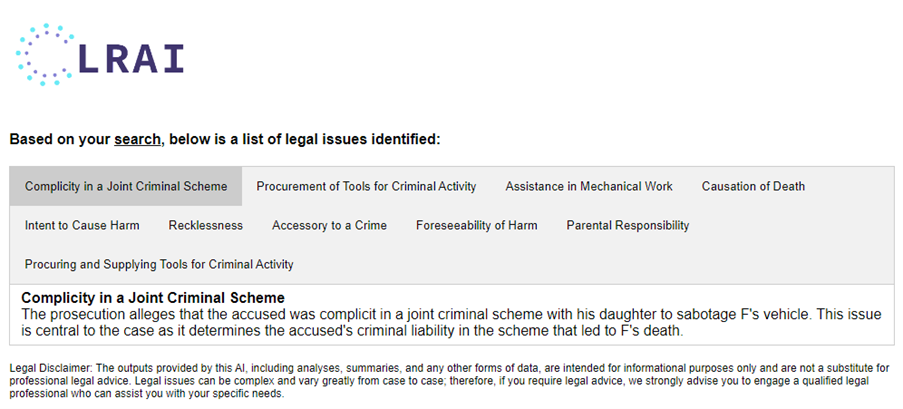
Under each issue, LRAI displays all relevant cases. You can assess their relevance by comparing the overall rank, context rank, and keyword rank. The higher the rank, the more pertinent the case is to your specific description.
For example, in the category of ‘Complicity in a Joint Criminal Scheme,’ the top five cases are:
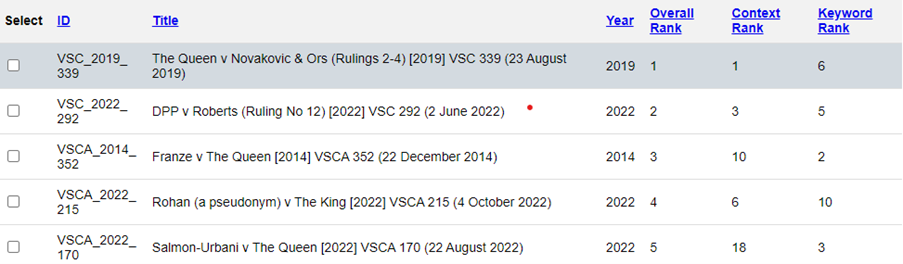
Each of these cases addresses accessory liability and joint criminal enterprise, offering comprehensive insights into how courts have interpreted and applied the law in similar situations.
If you prefer to look at the relevant legislation, our tool will guide you to relevant sections, like Crimes Act 1958 (VIC) section 324, ‘Person involved in commission of offence taken to have committed the offence’ (if you select this jurisdiction).

Join LRAI at lrai.com.au today to experience our amazing tool and transform your legal research process!